

Maine got the press conference.
Navatek got the contracts.
Collins got the PAC money.
The Navy got a slide deck.
Kao went to prison.
ProPublica released the key report in the contest between the two candidates for the Maine Senate seat this morning.
It wasn’t a leak or opposition research; it was a properly documented account of how the Hawaii-based defense contractor Martin Kao set up a system in Washington for receiving cash in return for contracts—according to Kao’s own version of events given to the FBI, Susan Collins was the most important supporter of this arrangement.
I’m going to stick to what’s actually on the record, not the campaign’s talking points.
If you have only two minutes, start here: a federal contractor unlawfully transferred $150,000 from a fictitious “women scientists” LLC into a Collins super PAC. Several weeks later, the CEO informed his own executives that Collins had carried out $32 million worth of work for the Navy. The boats the Navy paid to have designed were never delivered. The CEO is now in federal prison. The anti-corruption unit, which was still raising questions in 2024, was abolished after Donald Trump returned to office. The case is now over.
That concludes the story. What follows is the path that led up to it.
What is actually documented
Start with something that is not based on Martin Kao’s word.
In 2018, Kao asked for a meeting with Collins and was told he had to donate first; he did. During the same cycle, Collins arranged for an $8 million Navy research appropriation to be included in the defense bill for Navatek’s work on the hull with the University of Maine — the 3D-printed boat project based in Portland.
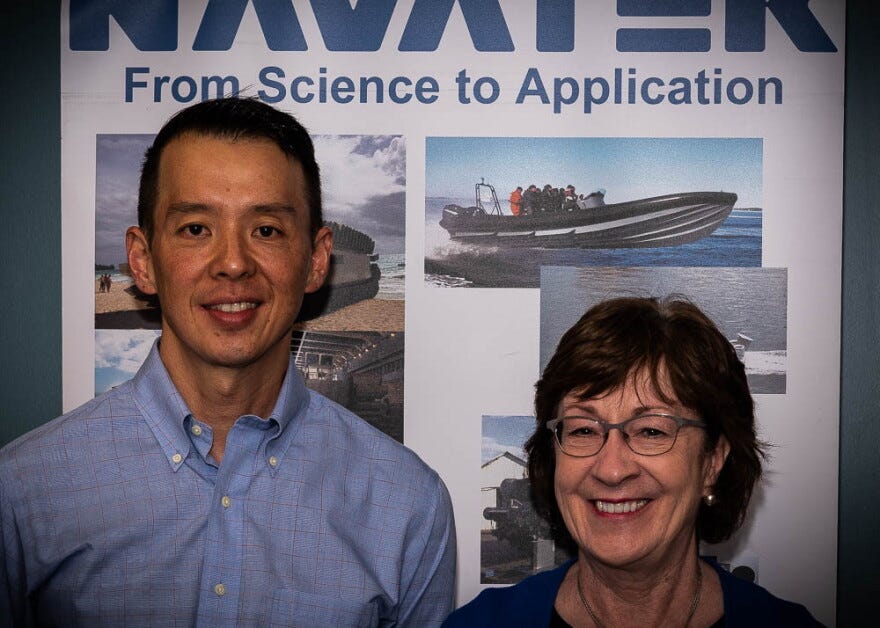
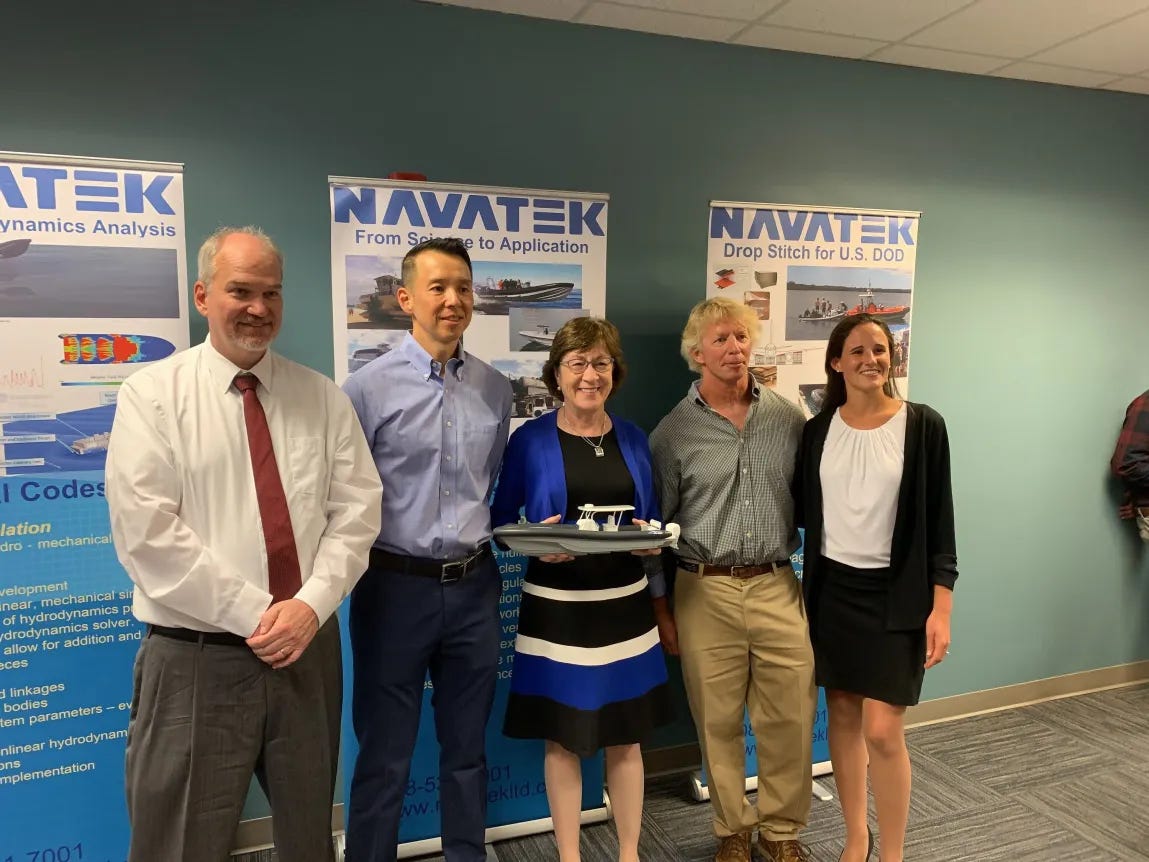
Navatek held a publicity event for a model boat at NavaTek Portland Office in August 2019.
In Washington, Scott Reed—who then was, and is now, a key figure in Collins’ outside-money operation—met with Navatek executives at a Corner Bakery. He requested that $500,000 be paid to the 1820 PAC, the super PAC supporting Collins in the fierce 2020 campaign. Afterward, when the FBI interviewed Navatek executives, they said their request in return was a guarantee of tens of millions more in federal contracts and a promise that Collins would know who had written the check.
Soon after the meeting, $150,000 was deposited at 1820 PAC from a recently established Hawaii LLC named the Society of Young Women Scientist and Engineers, although they had misspelled “Scientist.”
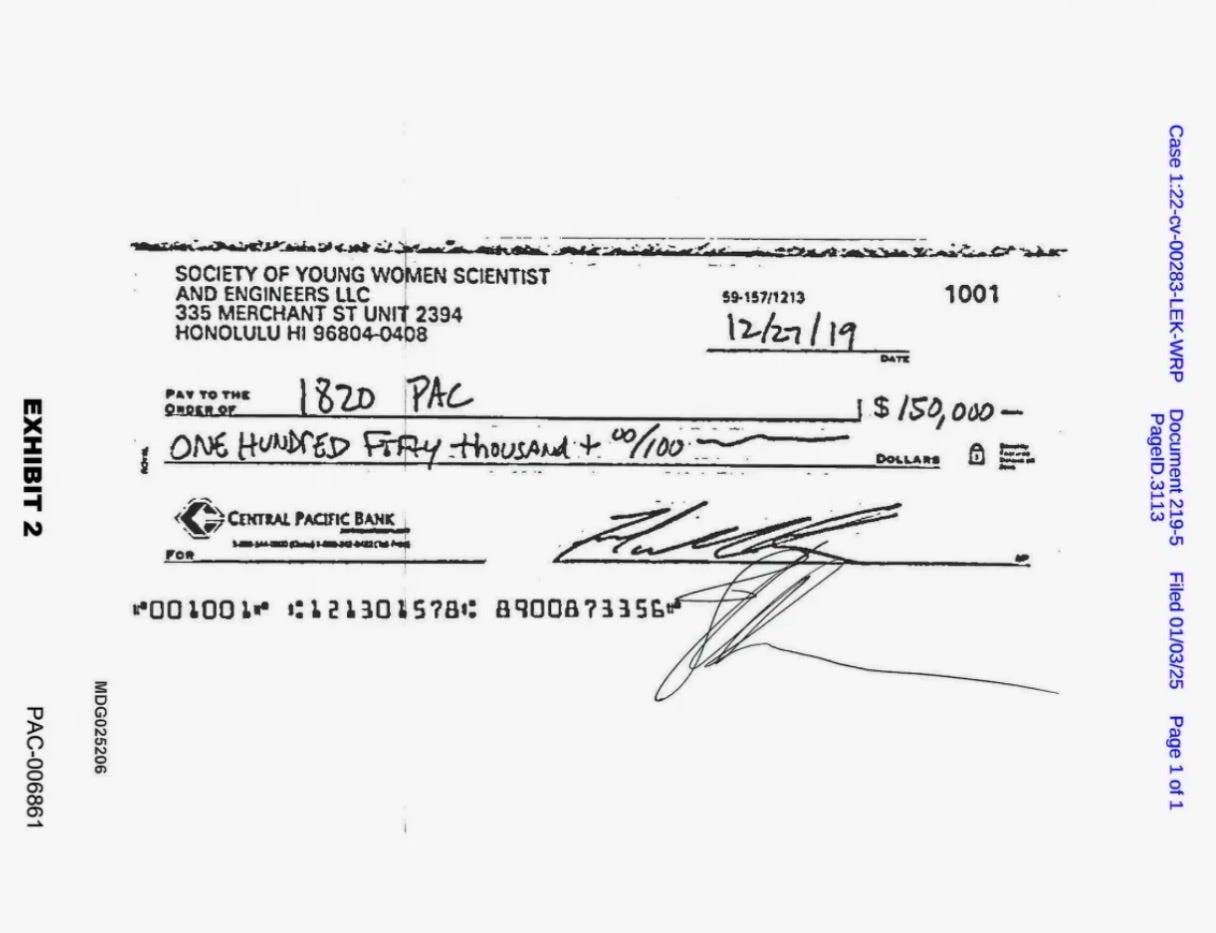
The funds did not originate with a women’s STEM charity; instead, they came from Navatek’s account. Federal contractors are not allowed to make such a donation. This is not a grey area; Kao later pleaded guilty to violating the law.
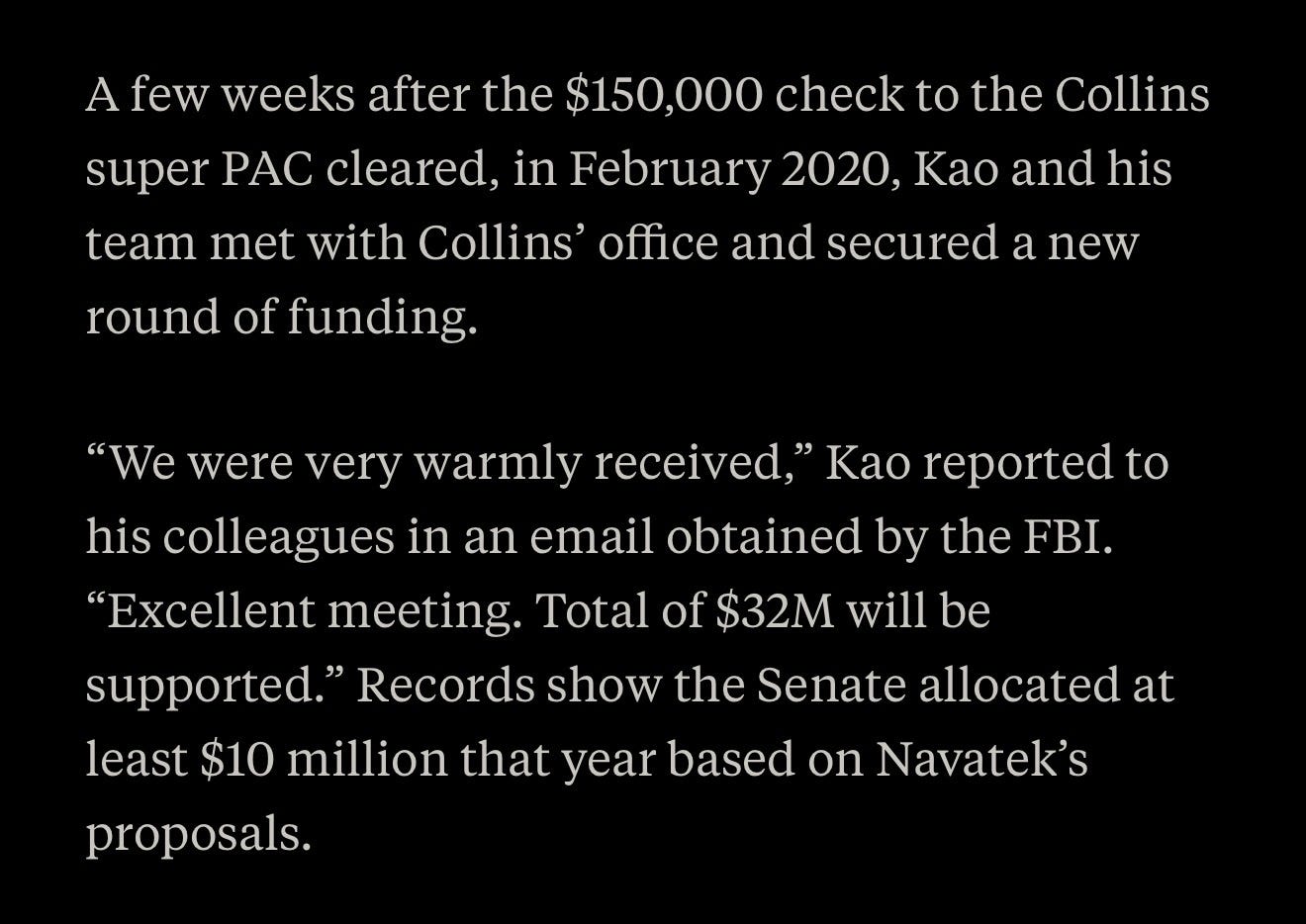
A few weeks after the check cleared, Kao and his team received a “very warm reception” at Collins’ office. In an internal email examined by ProPublica, Kao told his executives a version of the sentence that should appear on each of the flyers in this race:
“We were very warmly received. Excellent meeting. Total of $32M will be supported.”
Collins, in a meeting Kao later described to agents, put it more cleanly:
“You’ve seen me deliver.”
Then her staff requested the CEO’s phone number so that they could thank him personally.
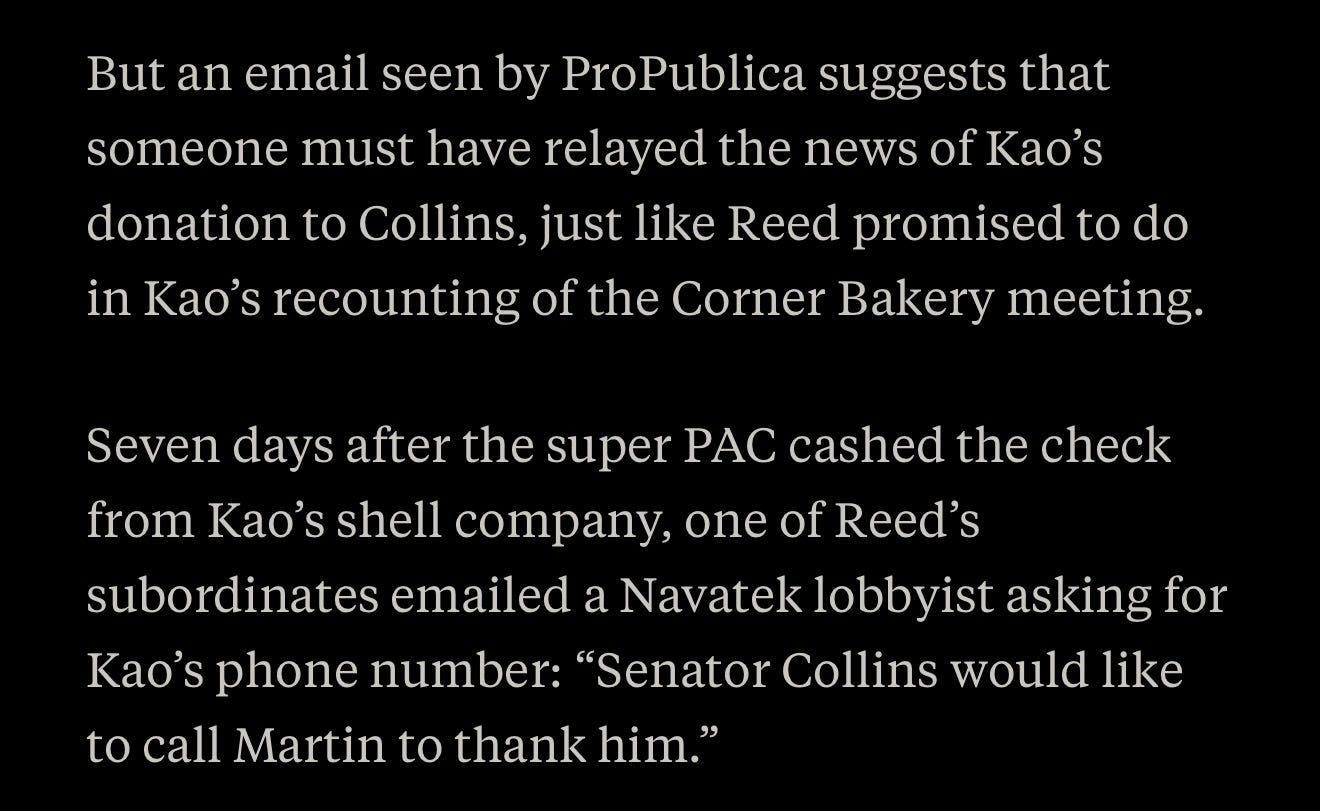
That sequence—access, money, use of appropriation language, and the thank-you call—is what is known as the Washington business model. ProPublica discovered checks being sent within 24 hours of key hurdles in the defense bill. According to the outlet, Collins was ‘its most important patron’ among all the members Navatek had approached.
What the Navy actually got
The section that should anger anyone who has ever completed a bid sheet or waited for a federal reimbursement.
According to the company itself, the government-sponsored projects it carried out in Maine produced almost nothing useful to the fleet. An ex-employee told ProPublica that the boats were never delivered because “the Navy didn’t want them at all.” The prototype eventually made its way into PowerPoint presentations and a white paper. One executive described the company’s approach as learning how to “thrive in the valley of death”—the area where research funds go and die without ever becoming a product.
Maine got the press conference.
Navatek got the contracts.
Collins got the PAC money.
The Navy got a slide deck.
If a shop in Brewer were to do that in a municipal tender, there would be a select-board meeting, and the county attorney would be involved. That procedure is known as appropriating in Washington.
Who Martin Kao is — and why that matters
He should not be turned into a choirboy. WONKSTACK isn’t involved in creating saints.
When Kao acquired Navatek, he used it as a political cash machine. With his network, he transferred almost $900,000 to politicians of both parties—yes, to Collins, but also to some names that will make certain of my readers recoil: Jim Clyburn, Dick Durbin, Jeanne Shaheen, Joe Biden’s operation, and Lindsey Graham. He unlawfully paid back relatives who had written checks. He was later convicted of a $13 million PPP fraud and, in September 2024, received a sentence of 87 months.
He went to the FBI after he had been caught; that’s what cooperators do. They also combine a desire for revenge with factual information. This is why you don’t draw up an indictment based solely on a cooperator’s testimony — and why the emails, the check through the shell company, the FEC complaint, the appropriations language, and the contemporaneous internal memos matter more than any single interview.
Kao’s line to the agents was crude and, if you have ever watched this town work, not hard to believe:
“It takes two to tangle.”
He spent several days going over the method with them, giving them a 50-page map and naming the staffers, the lobbyists, and the members. By the end of 2024, the agents in the Bureau’s public-corruption unit, CR-15, believed they had enough evidence to launch a wider bribery investigation—not a press release, but an investigation.
Here’s where the path divides.
What happened to the investigation
Two different things are being flattened into one sentence online today. Separate them.
First investigation, 2020–2021. The FBI raided Navatek’s Honolulu offices in September 2020. Prosecutors charged Kao with campaign-finance crimes and, later, PPP fraud. The Collins campaign says it cooperated, produced documents, and in 2021 disgorged the illegal Kao money it says it did not know was illegal — some of it, per reporting today, sent to rebuild a school in Frenchville that burned down. Deputy chief of staff Annie Clark calls Kao’s later accusations “outlandish” and “categorically false.” Ben Williamson, a spokesman for the FBI, said to ProPublica that the Bureau “ultimately found nothing that implicates Senator Collins or Senator Collins’ campaign. Any suggestion to that effect is completely false.”
The New York Times has now added a second official layer by having current and former officials familiar with the inquiry state that the agents found little evidence to support Kao’s specific allegations against Collins and Reed.
That’s nothing; it’s the defense, and it’s on the record.
Second inquiry, 2022 to 2024. Once Kao pleaded and started talking, CR-15 responded. It involved multiple-day interviews. The 50-page document contained questions regarding the Corner Bakery, questions about Collins, questions about Graham and a steak dinner in South Carolina, and questions about a list of members who had taken Navatek money while Navatek had taken public money.
ProPublica has shown that this second phase existed, that agents wanted to carry it out, and that it died down after January 2025.
The jury didn’t cause this; a personnel decision did. When Trump had Kash Patel as FBI director, he got rid of the unit that dealt with public corruption. The agent who had taken Kao’s confession — Michelle Ball — was dismissed in October 2025. According to the new organization chart, her offense was having previously worked on the 2020 election file. Her partner in the Navatek case, Kevin Gounaud, was removed in 2026. At the same time, the Justice Department’s Public Integrity Section was weakened. Prosecutors were instructed to halt work on any new corruption cases.
ProPublica’s sentence is straightforward: the investigation is now over. The government had stopped communicating with the informant who had provided them with a map showing how a mid-size contractor acquired a. You can regard Collins as having done nothing wrong and still consider it a scandal that the unit that could have tested that assertion was disestablished for reasons unrelated to Maine. Those two ideas can coexist in the same mind. That is what this publication is about. That is the entire point of this publication.
The part that is still sitting in Augusta
Scott Reed conducted the bakery meeting in 2019.
Amy Abbott ran the finance operation that handled the Kao network.
Both of them are mentioned in the news published today.
In 2026, both of them are still handling Collins’s money.
It isn’t an accusation of a new crime; it’s a personnel decision. The same company that cashed the check from the shell firm is now asking Maine voters for another six years.
Collins is positioning herself as the adult in the room, as the independent and as a buffer against Trump. Fox and the Portland Press Herald have already given the figure which makes that argument difficult to sustain: 55 percent of Maine voters are concerned about her connections with him. CNN’s recent portrayal of the race is even more straightforward in that it says the campaign is being waged on negative views of both Collins and Trump.
A senator who needs the FBI under Trump to close the file isn’t entitled to act as a check on Trump; that isn’t a matter of ideology, it’s a matter of arithmetic.
What this is not
Susan Collins was not indicted.
A jury has not found evidence of a bribe. In fact, no jury was appointed.
That doesn’t mean every dollar Navatek received was valueless; some of the UMaine composite work involves genuine research, even if the fleet never purchased the hull.
This is also not a claim that only Republicans do this. Kao’s donor list is a bipartisan embarrassment. If the next ProPublica chapter lands on a Democrat with an appropriations gavel, WONKSTACK will write that piece too. The method does not belong to one party. It belongs to the permanent class that treats the defense bill as a customer-relationship management tool.
It is a documented pipeline going from a contractor who had been banned, via a dummy LLC with a typo in its name, to a super PAC, alongside appropriations legislation and a thank-you call, referred to as pay-to-play by the person who managed the company, before being suppressed when the only team member left to investigate the claim was dismissed as a result of political revenge.
If that sentence leaves you unaffected, then you are not moderate; you are merely a spectator.
The Maine test
I have a simple test for this kind of thing.
If a lobsterman in Stonington had arranged for a no-bid contract to go to his cousin and had taken $150,000 via a dummy LLC, then we would know exactly what to call it. In that case, we wouldn’t have to carry out a 6,000-word investigation or use terms such as “patron,” “earmark,” and “disgorgement.” We would name it properly and expect a sheriff.
Washington has a different dictionary because Washington writes the dictionary.
Maine isn’t a company town for Navatek; it’s a state that has already seen its young people move away, whose harbors are competing for their share of the quota, and whose shipyard in Bath is actually doing the tough work—building the kind of ships the Navy wants. To accept the view that we should ignore a contractor who admitted the product had ‘no real value’ simply because the press conference took place in Portland is exactly how a state talks itself into losing its self-respect.
Collins has been a member of the Senate since 1997, a period longer than the time several voters in this election have been alive. Eventually, the argument that ‘she’s effective’ must meet up with the actual evidence of her effectiveness.
Effective at what?
For whom.
At what price.
They are not partisan questions; they are the only questions.
Read it yourself
Primary source, published this morning:
ProPublica — “The FBI Anti-Corruption Squad Was Circling Susan Collins — Until Trump Got in the Way”
— Maine