


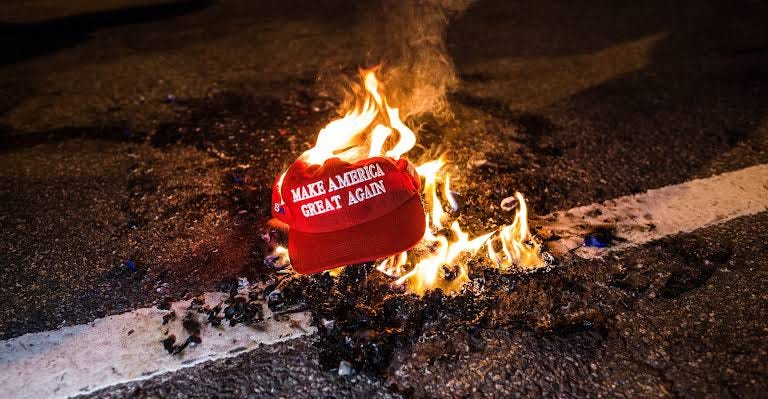
The MAGA base is still standing.
The majority that won 2024 is not.
Young men, Hispanics, Black switchers, and independents rented Trump on a price promise.
Twenty months later the receipt came due — and they’re gone.
Donald Trump’s 2024 victory was not due to a nationwide shift toward MAGA ideology. Instead, he secured support from voters outside his core base, including Hispanic men, young men, some Black voters, and working-class households who had traditionally voted Democrat. These voters were not joining a movement; they were seeking tangible outcomes such as lower grocery prices, improved border security, and reduced political turmoil.
Twenty months later, that expanded support has disappeared. Recent national surveys do not indicate a gradual decline or realignment; instead, they show the additional 2024 voters returning to previous patterns.
The MAGA core remains intact, but the broader 2024 coalition does not. These are distinct groups. “Broken beyond repair” does not mean Republicans have disappeared or that the 2028 election is decided. It means the majority coalition from 2024 has already fractured, with insufficient time this cycle to rebuild it.
This analysis draws on multiple sources, including New York Times/Siena, Reuters/Ipsos, CBS/YouGov, Quinnipiac, Economist/YouGov, Pew, and AP VoteCast for 2024. Approval averages range from the high 30s to about 40 percent, with some likely-voter polls reporting higher figures. Subgroup data, particularly for Hispanic, Black, and 18–29-year-olds, have smaller sample sizes and greater margins of error. The argument relies on consistent patterns across all available crosstabs, not on any single data point.
The coalition was never a conversion
First, consider the actual composition of the 2024 electorate.
Trump’s voters were still mostly white and still mostly without a four-year degree. Pew Research Center put white adults without a four-year degree at 51 percent of his coalition — the smallest share of that group in any of his three campaigns.₂ That is the tell. He did not win because the old base got bigger. He won because the old base held and he added just enough of everyone else.
The additional voters determined the election outcome:
· Pew’s validated-voter analysis found Hispanic voters went from a 25-point Biden blowout in 2020 (61–36) to a near split in 2024: Harris 51, Trump 48.₃ That was the largest partisan move of the cycle.
· Black voters doubled their Republican share, from 8 percent in 2020 to about 15 percent in 2024, per Pew and AP VoteCast.₄ The Council on Foreign Relations later called it the largest Republican share of the Black vote since Nixon.₅
· Young men flipped the youth math. AP VoteCast found Trump took nearly half of voters under 45 and lifted his 18–29 share from 36 percent in 2020 to 46 percent.₆ Young women did not come with them.
· Working-class voters across race became the Republican Party’s center of gravity. VoteCast showed white working-class men remaining the floor — Trump at 68 percent, a 38-point margin — while Hispanic and Black wThis group defines the 2024 coalition—not just the core supporters, but those who enabled the popular-vote victory. This distinction is central to the analysis.n matters, because the argument turns on it.
Their support was transactional, driven by concerns about inflation, border security, and a perception that current leadership viewed them as the problem. Trump promised quick solutions, and they responded accordingly.
When promised results do not materialize, transactional support diminishes. This is the primary reason the coalition has started to erode.
The case for “the coalition is fine”
It is important to consider the opposing perspective, as it is also supported by data.
Rasmussen’s daily tracker on Sept. 14 had 45 percent of likely voters approving and 54 percent disapproving. Harvard-Harris in late August was at 44 percent among registered voters. RMG Research was also in the mid-40s. Those houses are why a Republican operative can say, without lying, that “the averages are cooked, and he’s still in the game.”₈ Republicans still approve in the low-to-mid 80s. Times/Siena has white non-college likely voters at 53 percent approval. The people who were MAGA in 2016 are still MAGA.₉
Border security was also his relatively bright spot for most of the second term — the issue least underwater when the economy and Iran were sinking everything else. If you believe 2024 was mostly a border election, you can argue the new voters got the thing they wanted, and the rest is media weather.₁₀
This represents the strongest argument for coalition stability. However, the data continues to indicate otherwise.
Even the most favorable national polls show him below majority support. A 45 percent approval rating does not indicate a stable coalition; it reflects the upper range of an unpopular presidency. No poll with demographic breakdowns shows the 2024 expansion groups still supporting him. While some polls previously reported higher support among Hispanics and young voters, these figures remain well below the levels needed for a majority. The issue is not a lack of voters, but the loss of the additional support that created a majority.
Border security is no longer sufficient to maintain the coalition. By August, Strength in Numbers/Verasight reported negative ratings for every tracked issue, including border security. Gallup found immigration approval at 35 percent nationally and 21 percent among Hispanics. PRRI reported 35 percent favorable and 61 percent unfavorable on immigration handling. The issue that was expected to retain new voters is no longer effective.
The expansion layer has already peeled off
Focus on the current data from September 2026, rather than the results from November 2024.
The headline range is no longer in dispute.
Reuters/Ipsos, after last week’s RepublicanThere is now broad agreement on the current approval range. from a career-low 33 percent in late August.₁₃ CBS News/YouGov, Sept. 8–11: 39–61.₁₄ Quinnipiac, Sept. 3–6: 33–59.₁₅ Economist/YouGov, updated Sept. 15: 35 approve, 60 disapprove, net minus 25.₁₆ Silver Bulletin as of Sept. 11: net about minus 19.5.₁₇ RealClearPolitics and Ballotpedia: roughly 39–40 percent approve.₈ Different houses, same floor. That is midterm-wipeout territory.
The cleanest current demographic cut is Times/Siena, 1,503 likely voters, Sept. 8–13. Treat the subgroup point estimates as directional. The pattern is the point.₁₈
Young voters have inverted.
Times/Siena, ages 18–29: 18 percent approve, 78 percent disYoung voters have reversed their previous support.t. CBS in June had under-30 approval at 30 percent—already a collapse from 2024 —and it kept falling. Economist/YouGov spent the summer with net approval among 18–29 around minus 45.₁₉ A group that gave Trump roughly half its vote is now in open revolt.
Hispanic voters are no longer part of the 2024 coalition.
Times/Siena likely voters: 26 percent approve, 69 percent disapprove. Economy: 18 percent. The registered-voter cut is about 30. CBS in June: 31 percent. A 48 percent presidential share does not live at 26–31 percent job approval. That is reversion.
The Black share of support has already returned to historical Republican levels.
Times/Siena likely voters: 11 percent approve, 86 percent disapprove. Economy: 17 percent. CBS in June: 18 percent. The protest spike is over.
Independent voters have withdrawn their support.
Times/Siena: independents 27 percent approve. PRRI in June put favorability among independents at 25 percent, down from 37 percent in September 2024.₂₀ Independents put him over. They are not staying.
Those four groups were the 2024 expansion. They are why a popular-vote win existed. They are also the groups now printing 2020 numbers, or worse.
This is what is meant by ‘broken.’ The Republican Party remains, but the additional support that created a majority has disappeared just seven weeks before the midterm. The difference between the base and the broader coalition is therefore significant.
Two Trump-voter numbers, not one
At this point, it is important to present both key data points for a comprehensive analysis.
Times/Siena’s likely-voter sample: 82 percent of 2024 Trump voters still approve of the job he is doing.₁₈
The Economist, using YouGov: one in five of his 2024 voters now disapprove. Only 65 percent of 2024 Trump voters plan to vote Republican this fall, versus 76 percent of Harris voters planning to vote Democratic. Among the defectors, YouGov finds 10 percent of Black Trump voters and 7 percent of Hispanic Trump voters already saying they will vote Democratic, plus 5 percent of white Trump voters under 30.₁
Those figures do not cancel each other. They measure different things.
Siena surveys likely voters in September regarding presidential approval, capturing those who remain engaged. YouGov surveys the broader pool of 2024 Trump voters about their intentions for November, including those who are less engaged. Approval does not equate to turnout, and likely voters do not represent the entire coalition. While core supporters remain loyal, the coalition’s periphery—comprising younger, non-white, and less MAGA-aligned voters—is increasingly disengaged, as reflected in YouGov’s findings.
If only Siena’s data were considered, the coalition would appear stable among likely voters. However, if YouGov’s assessment of midterm intentions is accurate, the 2024 additional voters do not need to switch parties to weaken the coalition; they simply need to abstain at higher rates than Harris voters. This dynamic can result in losing the House, even if the coalition appears strong on paper.
The base is not the coalition
White voters without a college degree still give Trump his best numbers. Times/Siena: white non-college 53 percent. CBS in June: 52 percent. Republicans: low-to-mid 80s. PRRI: 79 percent of Republicans still favorable. Strong MAGA identifiers in Economist/YouGov remain north of 90.₉
This group represents a movement, but it does not constitute a majority.
And even the base is softer than the speeches. Fifty-three percent approval among white non-college voters is not 65 to 68 percent of them on Election Day. By June 13 the New York Times had white working-class voters disapproving of his economic handling in Fox (33 percent approve), CBS (39), NPR/PBS/Marist (40), CNN (43), and Times/Siena (47). Cost-of-living approval among blue-collar whites in Times/Siena was 36 percent.₂₁ The floor is cracked. It has not collapsed. The expansion layer has.
A coalition is built in layers. When the upper layers are lost, what remains is only the core, not the full coalition.
The coalition fractured because the promised outcomes were not delivered.
The data suggests the primary factor was not a reversal of cultural alignment, but rather unmet expectations regarding cost of living.
Economist/YouGov: 72 percent of Americans say tariffs have raised prices; 64 percent disapprove of how he is handling the issue. Among young and minority voters: 74 and 71.₁ Times/Siena cost-of-living approval is in the mid-20s nationally. Economy approval among likely voters is 39 percent overall — 19 percent among 18–29, 18 percent among Hispanics, 17 percent among Black voters.₁₈ That is the coalition-killer. You cannot run a working-class realignment while the working class thinks you made the cart more expensive.
Pew and the Beyond MAGA typology found that the 2024 electorate was more diverse, as many first-time voters participated as a form of protest. According to Beyond MAGA, only 38 percent of Trump voters considered being MAGA important.₂₂ While hardline supporters exist, they were never the majority. When protest voters feel their expectations are unmet, they tend to disengage rather than become activists.
Iran sits on top of that. Many in the new coalition voted for cheaper energy and less entanglement. The Economist found 57 percent of voters think the Iran decision was a mistake, and that the post-war approval drop hit Black, Hispanic, and young white voters first.₁ That is correlation, not a signed affidavit from every switcher. It is also the simplest story the crosstabs allow: prices first, war second, identity last.
Current polling for the midterm indicates a clear trend: Reuters/Ipsos reports Democrats leading Republicans 44 to 37, the largest gap since Trump returned to office.₁₃ Ballotpedia’s September 14 index shows Democrats with a six-point advantage.₈
Why the coalition cannot be rebuilt in time
Coalitions typically fracture in two ways: either the core supporters defect, or the expanded layer withdraws, leaving only a vocal minority.
This is the second one. You do not fix it with a rally in seven weeks.
It is not possible to regain support from Hispanic men with only 18 percent economic approval through rhetoric alone. Similarly, 18-to-29-year-olds with 18 percent job approval and independents with 25 percent favorability are unlikely to be persuaded by campaign promises, such as a $5,000 dividend, which Reuters/Ipsos found was rejected by 63 percent of respondents, including 40 percent of Republicans.₁₃
Restoring the coalition would require a noticeable decrease in the cost of living before the election, which is a matter of policy, not messaging. Public opinion on this issue is already clear and consistent across polls. Young voters, Hispanic voters, Black swing voters, and independents have expressed their dissatisfaction. Even some 2024 Trump voters have indicated their intent through midterm polling, despite still identifying as Trump supporters.
Those who continue to support Trump until November are his core base, not the broader 2024 coalition. They represent what remains of the original coalition.
While the political brand may endure, achieving a majority in this cycle is no longer feasible.
The 2024 Trump coalition was a temporary alliance based on economic concerns. These voters have evaluated the results and are not renewing their support before Election Day. No new group of supporters is likely to emerge in time.
This is not a temporary setback; it marks the end of the coalition that secured victory.
Notes
₁ The Economist, “Donald Trump’s disintegrating coalition,” Sept. 10, 2026; YouGov polling for The Economist.
₂ Pew Research Center, “Behind Trump’s 2024 Victory: Turnout, Voting Patterns and Demographics,” June 26, 2025; Pew Research Center, “Detailed demographic profiles of Trump and Harris voters in 2024,” June 26, 2025.
₃ Pew Research Center, “How voting patterns changed in the 2024 election,” June 26, 2025.
₄ Pew Research Center, “How voting patterns changed in the 2024 election,” June 26, 2025; AP VoteCast, 2024.
₅ Council on Foreign Relations, “The Trump Coalition,” 2026.
₆ Associated Press, “AP VoteCast: How Donald Trump built a winning 2024 coalition,” Nov. 8, 2024.
₇ Wall Street Journal, “Trump and Republicans Win With Working-Class Voters Across Racial Lines,” citing AP VoteCast, 2024.
₈ Rasmussen Reports Daily Presidential Tracking Poll, Sept. 14, 2026 (45% approve / 54% disapprove among likely voters); Ballotpedia polling index, Sept. 14, 2026 (presidential approval average 40%; generic ballot Democrats +6), including Harvard-Harris (44%, Aug. 28–30) and RMG Research (44%, Aug. 31–Sept. 8).
₉ New York Times/Siena College, Sept. 8–13, 2026; CBS News, June 17–19, 2026; PRRI, June 2026; Economist/YouGov MAGA-supporter crosstabs, 2026.
₁₀ Fox News poll, Jan. 2026: 52% approved of Trump on border security (then his only net-positive issue in that survey).
₁₁ Rasmussen Reports weekly likely-voter crosstabs, June 14–18, 2026 (Hispanic 51%; ages 18–29, 37%).
₁₂ Strength in Numbers/Verasight, Aug. 14–19, 2026 (underwater on all 12 tracked issues; border security net −5); Gallup, June 2–26, 2026 (immigration approval 35% nationally, 21% among Hispanics); PRRI, 2026 (immigration handling 35% favorable / 61% unfavorable).
₁₃ Reuters/Ipsos national poll, published Sept. 14–15, 2026 (1,143 adults; MoE ±3). Prior wave: Aug. 28–31, 2026 (33% approve). Generic ballot: Democrats 44, Republicans 37. On the $5,000 dividend: 63% disapproved.
₁₄ CBS News/YouGov, Sept. 8–11, 2026 (2,460 adults; MoE ±2.3).
₁₅ Quinnipiac University, Sept. 3–6, 2026 (970 registered voters; MoE ±3.9).
₁₆ The Economist/YouGov presidential approval tracker, updated Sept. 15, 2026.
₁₇ Silver Bulletin, Trump approval average, updated Sept. 11, 2026.
₁₈ New York Times/Siena College national poll, Sept. 8–13, 2026 (1,503 likely voters; registered-voter crosstabs published Sept. 15, 2026). Likely-voter job approval: 38% approve, 59% disapprove. Subgroup n’s are smaller: 18–29, n=250; Hispanic, n=170 registered / ~113 on some issue splits; Black, n=193 registered.
₁₉ CBS News poll, June 17–19, 2026 (2,519 adults; MoE ±2.4). Economist/YouGov tracking, June–September 2026, as reported by The Economist and Newsweek.
₂₀ PRRI, “Competing Visions of America at 250,” June 2026. Trump favorability: 34% overall; 25% among independents; 79% among Republicans.
₂₁ New York Times, “Trump Is Losing Ground With White Working-Class Voters on the Economy,” June 13, 2026.
₂₂ Beyond MAGA, “A Profile of the Trump Coalition” (more than 10,000 Trump voters, concluding early 2026).