



A country that will not train its own welders, network engineers, and surgical techs will import them, then call the result diversity or a skills shortage depending on the channel. Both explanations are a dodge. The fix is the same bill: My American Workers First Act.
Bo French viewed the University of Texas student section and perceived an invasion.
John Cornyn saw in Bo French a sign of internal conflict within the Republican Party.
Donald Trump saw both situations as an opportunity to gain political leverage without legislating, since doing so would require choosing between Elon Musk’s labor model and American workers. That tension frames the week’s political fight.
This week in Texas centers on a culture war over university identity, a labor market with longstanding issues, and an administration promoting ‘AMERICAN WORKERS FIRST’ while suggesting Americans lack talent. That mix sets up the debate that follows. The throughline is simple: identity politics, labor scarcity, and policy inconsistency.
I published The American Workers First Act in November 2025. While the data has changed, the underlying issues remain. This update keeps the policy focus on American workers and highlights ongoing obstacles. I also discuss pathway to getting it passed.
For the statute, proceed to Part III. For context on the broader debate, begin here. These two paths separate the policy text from the larger dispute. Use both to follow the argument.
Part I — French’s argument is flawed, but the underlying concern is valid. This section starts with the football controversy and then widens to labor. The point is not his method; it is the issue beneath it.
Start with the football controversy, while keeping the broader labor system in mind. The point is to move from the campus dispute to the larger machine. That broader system is the real subject.
On September 13, Bo French, GOP nominee for Texas Railroad Commissioner and former Tarrant County GOP chair, posted an image from the Longhorns student section after Texas defeated Ohio State. He claimed that UT graduation ‘looked like this,’ expressed disbelief, and stated, ‘the problem is now obviously far worse than anyone imagined.’ He further asserted that social media reveals ‘how many Americans have been displaced by foreigners.’
John Cornyn, recently defeated in a primary and focused on his reputation, publicly condemned French’s comments as intolerant and racist, questioning whether other Republicans would ignore such rhetoric. Greg Abbott had already criticized French’s suitability for office. Democrats also criticized French. Responses to Cornyn’s statement included comments such as ‘America is for Americans’ and more extreme views.
It is important to acknowledge that while French’s approach is flawed, the underlying grievance is legitimate.
UT Austin, fall 2025, from the university — not from a Telegram channel:
• 55,000 students
• 80.5% Texas residents
• 10.2% from other U.S. states
• 9.3% international (5,140 on the official books)
• Freshman class of 9,900, and Texas law already requires 90% of those freshmen to be Texas residents.
• International enrollment is a graduate story: 4,873 international graduate students, 1,923 undergraduates.
• Texas Global’s wider net (Option III, English Language Center): 6,877 international students. India first at 1,660. China. A concentration of South Asian students in the section is unsurprising. Collin County and Fort Bend have sent many high-achieving students to Austin through the Top 10% rule. Friends often sit together, and broadcast cameras can distort perceptions. None of this requires F-1 visas, nor does it justify assumptions based on appearance.
Cornyn is correct that one cannot assume students are foreigners based on appearance. However, despite supporting hire-American rhetoric in the Senate, he did not advance corresponding policies. Public condemnation is not a substitute for legislation. Keep the focus on the bill.
The machine is not the football team. It is this:
F-1 student visa (uncapped, university-controlled) → CPT during school → OPT (12 months) → STEM OPT (24 more months) → H-1B lottery (85,000) → employment-based green card (backlogged for Indian nationals for decades).
H-1B gets the hearings. OPT is the quiet on-ramp. OPT has no annual numerical cap. The employer pays a student-adjacent wage. The university keeps the tuition. Congress gets to say the cap is “only 85,000,” while the pipeline keeps expanding. The policy stake is how this pipeline shapes wages, training, and hiring incentives.
Texas is where you can see it without a spreadsheet. 97,043 international students in 2024/25 — third in the country. India: 43.9% of them. The volume campuses are UNT, UT Dallas, UT Arlington, Texas A&M, then Austin. That is DFW and the I-35 corridor. That is the labor market Ken Paxton wants to run for Senate on “the American dream,” without ever describing it. The policy stake is whether that market keeps relying on OPT or turns toward domestic hiring.
Nationally, Indian enrollment in the U.S. fell 6.9% from February 2025 to February 2026 — 378,787 to 352,644 — after F-1 refusals hit 41%. That did not end the fight, because the fight is about a twenty-year stock of workers in specific metros, not this fall’s incoming class. The policy stake is whether lawmakers address that stock or treat it as a temporary flow.
Part II — Update the board. Then name the people sitting on it. Now that the machine is on the table, update the record and name the players. The next step is to identify who is driving the system. Keep the board in view.
Now that the machine is on the table, update the record and name the players. Keep the board in view as the discussion turns to the people behind it. Move from structure to actors.
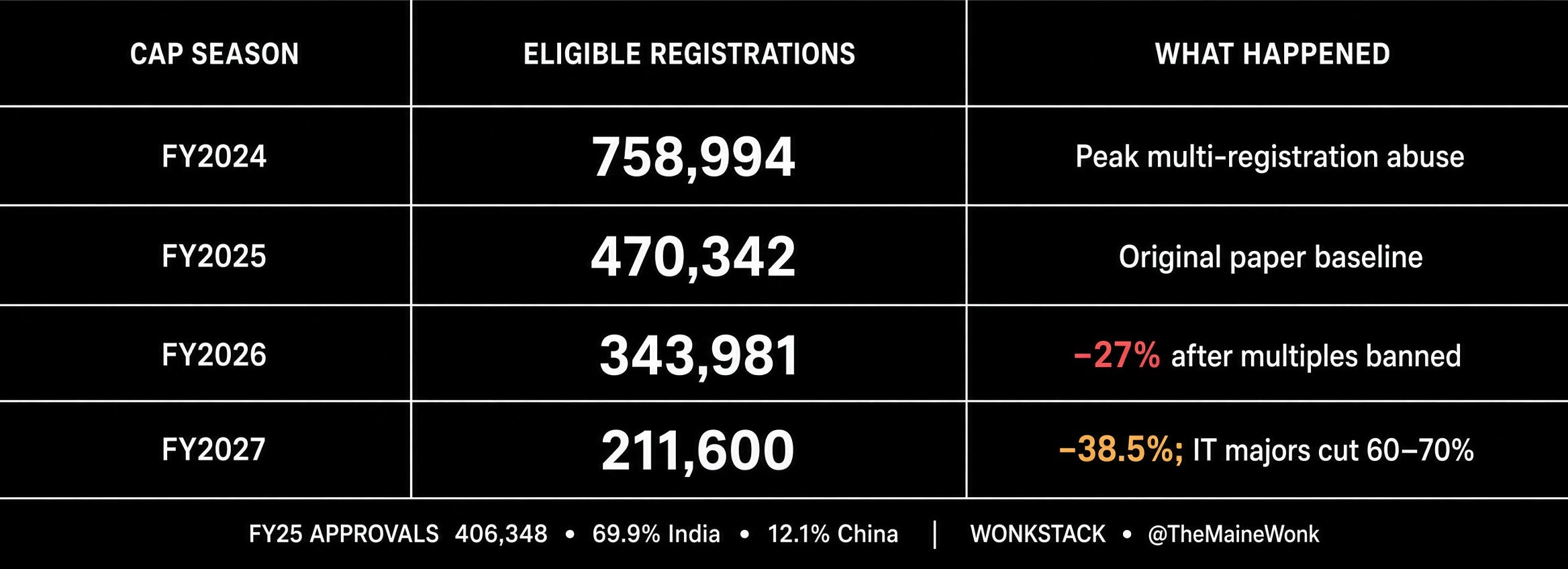
Two things are true. The lottery-fraud era is receding. The program is still a concentrated foreign-labor channel. USCIS FY2025: 406,348 approvals, 283,772 for India (69.9%), 49,161 for China (12.1%). Computer occupations are still the majority. Most approvals are extensions. Temporary, on paper. A parallel career system, in practice. That is the record before turning to the employers. The policy stake is whether this system sets hiring norms in place of domestic training.
When Tata and Infosys reduce new cap cases, they do not invest in local workforce development. Instead, they extend existing arrangements, offshore work, and anticipate automation to reduce entry-level positions. This is not a skills strategy, but a temporary staffing adjustment. The administration has promised a manufacturing revival but has instead delivered increased automation and reliance on foreign labor. Evaluate both the promises and the outcomes.
The hypocrites, by name
Donald Trump campaigned on this issue, and his Department of Labor promotes the slogan. However, he has told firms that Americans lack talent and that H-1B visas are essential for staffing. The real issue is the absence of a training pipeline, which companies have not developed. Prioritize American workers, not a labor model that undermines them.
Elon Musk stated in December 2024 that he would strongly advocate for H-1B visas. His position supports access to lower-cost, globally sourced talent. While he is entitled to this view, it should not be presented as a patriotic imperative or used to challenge legislative oversight.
Vivek Ramaswamy’s comments suggest a belief that native-born students are culturally disadvantaged. This perspective discourages investment in domestic training and instead favors importing talent under the guise of merit. This is not a genuine skills argument, but rather a dismissive stance.
Lori Chavez-DeRemer’s initiatives, such as Operation Firewall and raising the prevailing wage, are useful tools but do not address the need for a domestic workforce. The Department of Labor can enforce regulations inconsistently. These measures should change incentives, not be presented as comprehensive solutions. The policy stake is whether they build capacity or merely adjust the margins.
Bo French should not be considered for statewide office if his approach relies on racial assumptions. Addressing legitimate H-1B concerns requires legislative action, not public complaints. He should focus on policy or withdraw. The policy stake is whether grievance turns into reform.
John Cornyn’s condemnation was appropriate but inadequate. Despite his seniority and influence, he did not advance hire-American legislation. That inaction is part of the party’s internal challenge.
Chip Roy and Eli Crane. Roy’s American White-Collar Worker Jobs Act — wage-based selection, hire-American attestation, layoff lockout, end of OPT as a shadow work visa — is the restriction half of this paper. Crane’s pause-and-rewrite is the blunt instrument. They are the only two Republicans in this story who wrote something that can be scored. Use them to change the system, and move from critique to action. The policy stake is whether any of these proposals become enforceable constraints.
Ken Paxton. He is in a competitive Senate race against James Talarico. While he references the American dream, Texas’s technology sector relies heavily on OPT. To appeal to working-class voters, he should support hire-American policies and GI Bill 2.0 rather than partisan rhetoric. Say the quiet part out loud about H-1B composition. Saying it is not passing it. Florida does not get to lecture Texas while the same pipeline feeds both states’ hospital systems and IT benches.
Part III — The American Workers First Act. My November 2025 proposal remains central. This week’s update adds a campus-focused provision and aligns the bill with existing legislative vehicles. Stay clear on the policy objective:
Title I — Domestic capacity
Expand registered apprenticeships with a national target of one million active positions. Priority areas include software, cybersecurity, semiconductor technology, industrial maintenance, electricians, HVAC-R, welding, allied health, and transmission.
If the only path to becoming a mid-level engineer requires a four-year degree, unpaid internship, and referral, the system will inevitably import talent to fill gaps. Paid 24-month apprenticeship tracks with employer accountability address this issue.
Offer short-term, stackable vocational programs at community colleges, ranging from three to twelve months, designed for individuals with existing work or family commitments. Tie funding to successful job placement.
Trades capital: booths and instructors, not another PowerPoint from the Department of Labor.
Require clear identification of labor shortages before awarding grants. Publish shortage data and reclaim funds from unsupported programs.
Title II — GI Bill 2.0
The original approach worked because it was generous, time-limited, and tied to institutions that had to perform. Build the civilian version.
• Who: unemployed for four weeks or more due to layoff, automation, or trade. Veterans first.
• What: $30,000 training, $1,500–$2,500 stipend, health bridge, placement.
• How long: 36 months, stackable. 30-day clock. Not a two-year WIOA odyssey.
• Scale: one million beneficiaries, feeding five million placements.
Both progressives and populists can support this initiative. Retain this provision to facilitate passage of the broader bill. The policy stake is whether this common ground helps move the larger package.
Title III — Hire American, with audits
Adopt the approaches proposed by Roy and Crane rather than creating less effective alternatives.
1. Wage-weighted H-1B selection. Highest real wage first.
2. 30-day American recruitment on a public board at the offered wage. DOL random audit. Lie, and you are debarred for three years.
3. Layoff lockout. Occupational layoffs in an SOC code in the last 12 months mean no new H-1B or OPT in that code. The Disney-in-Florida file: Ensure that prevailing wage standards are enforced, eliminating the use of Level 1 wages as a loophole. Provide fee exemptions for small firms, recognizing that a 20-person business in Austin differs significantly from large multinational corporations. Infosys.
Title IV — The campus pipeline the original paper underweighted
This provision is particularly relevant to Texas and will likely face opposition from universities, underscoring its significance.
• OPT wage floor equal to the H-1B floor for the same SOC and metro.
• Public OPT employer file: headcount, SOC, wage, layoff history.
• Cap the duration of STEM OPT unless the position pays at or above the 75th percentile for that occupation in the relevant metropolitan area. Recognize extended training periods as employment.
• Any graduate CIP code where F-1 For any graduate program where F-1 students represent a significant proportion, publish data on domestic applications, offers, F-1 student share, and OPT placements. Prioritize transparency, with caps considered if issues persist. For programs that function as work-visa mills. Hit the money.
Title IV does not include measures based on visual assessments or racial profiling at events, nor does it address social dynamics unrelated to policy.
Title V — Pay for it without a tax hike
$10–15 billion a year. The annual cost is $10–15 billion, to be covered by budget offsets rather than speculative funding. WIOA, Job Corps, and YouthBuild cannot show placement. The Adult formula alone is still in the high-$800 millions. Stop paying to warehouse people.
• Direct H-1B and OPT employer fees into a Domestic Skills Investment Fund. Use any surcharges to train American workers, ensuring transparency and accountability.
• Restrict the tax deductibility of offshore replacement labor in the occupational codes targeted by the Domestic Skills Investment Fund.
• Require employers to provide a 30–50% match for apprenticeship positions.
• Pay-for-success against UI savings, with clawbacks attached.
Studies show apprenticeships yield approximately $1.47 in returns for every dollar invested, with payback periods of five to seven years. This program must remain deficit-neutral to succeed in reconciliation.
The goal is to place 5 million additional Americans in shortage occupations by 2036 and reduce structural H-1B dependence by 20–30%. The objective is not to eliminate foreign workers or open caps, but to ensure the country can meet its own workforce needs.
Part IV — How this passes, and who has to move
A mid-2026 signing is no longer feasible. Adjust the legislative strategy to the current timeline.
• Attach Title III to Chip Roy’s existing bill, which has already been introduced.
• Include Title IV as an amendment, taking advantage of recent developments that have made its passage more attainable.
• Present Titles I and II in the Education & Workforce and HELP committees as companion skills legislation. Ensure the bill is scored and included in the next reconciliation window.
• Pilot the program in 15 states during the first year, including Texas. Establish program sites in Austin, Dallas, Houston, and relevant industrial locations, focusing on implementation rather than publicity.
House Republicans can enact restrictions this winter, but maintaining their coalition requires more than reducing the lottery without investing in workforce development. Senate Democrats may continue to cite concerns about racism if substantive alternatives are not presented. Implementing GI Bill 2.0 addresses these issues directly.
Trump can sign this tomorrow and give real meaning to the administration’s stated priorities. Alternatively, he can keep prioritizing corporate interests over American workers. His actions will demonstrate his true priorities. Place to run immigration policy. It is a perfect place to start a fight that produces no welders, no network engineers, and no surgical techs.
Bo French started the controversy; John Cornyn responded with moral arguments; Donald Trump seeks to leverage it politically; Elon Musk supports policies that lower labor costs; Vivek Ramaswamy frames it as a cultural issue; and Ken Paxton calls it the American dream. Chip Roy and Eli Crane have at least contributed substantive proposals.
I wrote the other half.
The proposal aims to create 5 million jobs, implement hire-American rules with audits, introduce GI Bill 2.0, and reform OPT and H-1B programs, all without increasing income taxes.
The stands will look like America. The payroll should too. Call the fucking vote and let’s FINALLY and ACTUALLY put the American Worker first.
— Maine