


GOP PACs began significant spending in Texas only after polling indicated a competitive race. Large financial investments are made when a race is at risk, not when it is secure.
Two new polls were released today. Neither shows a 14-point Republican advantage.
ReconMR/Siena has James Talarico up six, 49–43. Emerson/Nexstar/The Hill has him up one, 47–46, with a positive favorability score against Ken Paxton’s underwater numbers. Mason-Dixon earlier this week: 46–43. 270toWin’s five-poll average as of this morning: Talarico 47.4, Paxton 44.4.¹
This is not a close race that favors Republicans, given Texas’s history. A Democrat is consistently leading in a state Donald Trump won by 13.7 points just 22 months ago. As the Texas Tribune’s tracker noted this morning, Talarico is showing larger leads than Beto O’Rourke ever achieved against Ted Cruz in 2018. This is the clearest sign yet that the race is moving away from the 2024 baseline.
The cause is clear: the 2024 coalition is fracturing along the same lines that once unified it, and the polling below shows how that fracture is now showing up in the race.
Composition of the 2024 coalition
Certified 2024 result: Trump 6,393,597 (56.14 percent), Harris 4,835,250 (42.46 percent). Margin: 13.68 points and 1.56 million votes.³ In 2020 it was Trump 52.06, Biden 46.48—a 5.58-point race.⁴ The Republican presidential margin in Texas more than doubled in four years.
Two groups were responsible.
Hispanic Texans. Edison’s Texas exit poll put Trump at 55 percent of Latino voters, up from 41 percent in 2020 and 34 percent in 2016.⁵ Democratic ID among Texas Latinos had already fallen from 65 percent in 2016 to 45 percent by December 2024.⁶ The Valley flipped. Starr went Republican for the first time since the 1890s. Hidalgo went Trump. That was the earthquake.
College-educated Texans. Nationally, Pew had Harris winning degree-holders by 16 points.⁷ In Texas, Edison had college graduates tied 49–49. Non-college went 61–38 for Trump. White college graduates still leaned Republican, 57–41.⁸ Republicans did not win the professional class. They stopped the bleeding. That is the difference between a six-point state and a 14-point state.
To summarize: a spike among Hispanic voters combined with a stalemate among college-educated voters created the majority. That same coalition is now breaking apart, and recent polling indicates those gains are not transferring to Ken Paxton.
The Hispanic majority has shifted.
Emerson’s director, Spencer Kimball, said the quiet part this morning: “Texas Hispanic voters, who broke for Trump in 2024, now break for Talarico by 15 points, 54 percent to 39 percent. These voters disapprove of the president 53 percent to 41 percent.”⁹
This result aligns with other findings that reinforce the same shift:
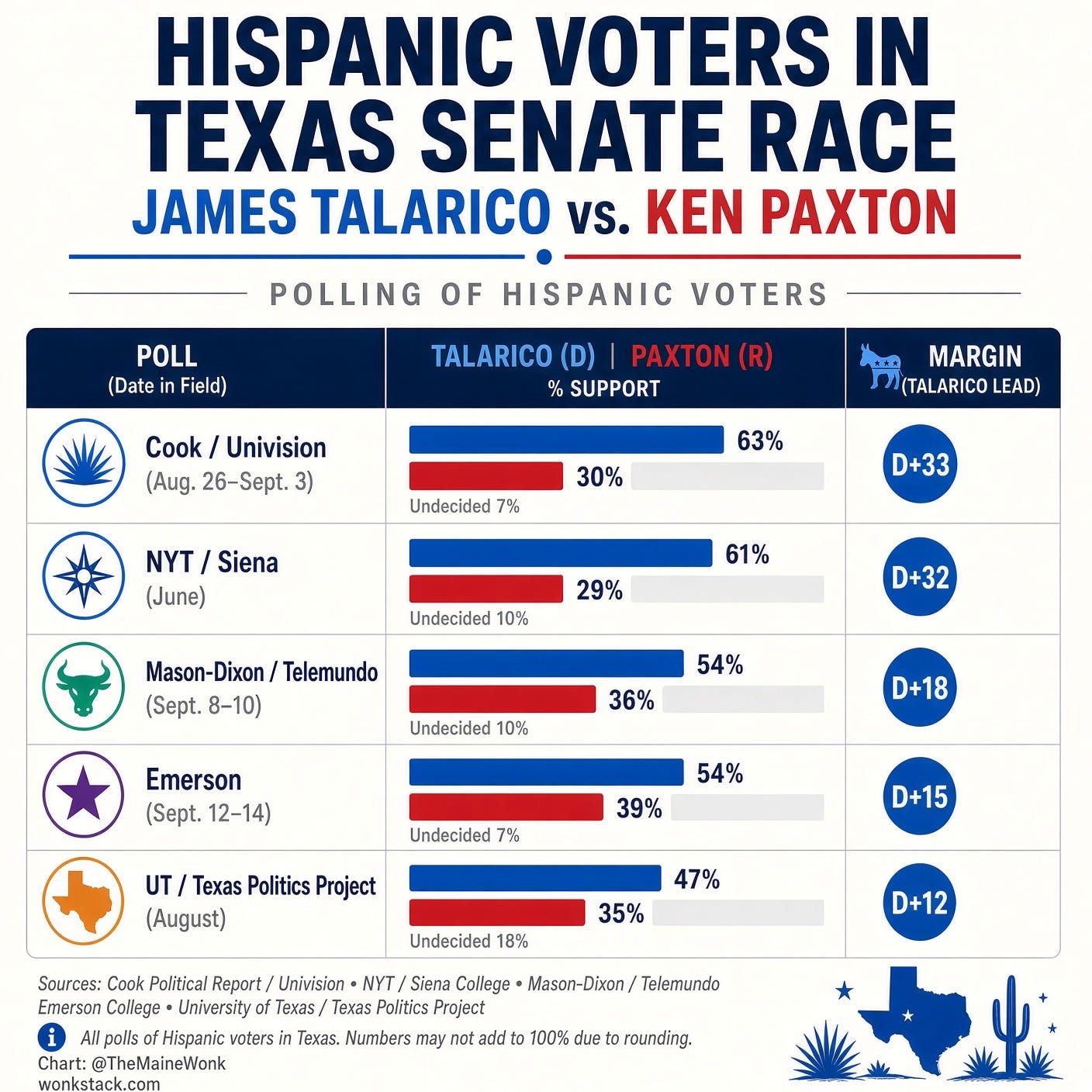
Cook and Univision surveyed Rio Grande Valley districts that showed the strongest support for Trump in 2024. Statewide, Hispanic likely voters favor Talarico by a two-to-one margin. Trump’s job approval among Texas Hispanics is 33 percent. Eighteen percent of Hispanic Trump voters from 2024 now disapprove of his performance. Nearly two-thirds are less likely to support a candidate who backs his deportation policy. The economy remains the top issue, surpassing immigration by a two-to-one margin.¹⁰
James Henson at the Texas Politics Project cautioned last winter that using 2024 as the Latino baseline “is going to overestimate Republican turnout. Period.”¹¹ His assessment was accurate. The 55 percent Latino support for Trump was specific to that candidate and moment, and that is why it does not extend to Paxton.
The stalemate among college-educated voters has also ended, as the next surveys show.
August Texas Politics Project crosstabs: four-year degree Talarico 47–37, post-grad 50–38, independents 37–11, moderates 47–16, women 46–33.¹²
Mason-Dixon this week: women 52–36; Talarico, ages 18–34, 51–37; independents 51–30.¹³
According to ReconMR, independents now favor Talarico 64–24, up from 53–30 in July. In Dallas–Fort Worth, Talarico leads with 58 percent, while Paxton leads in rural Texas with 60 percent. These results show the same pattern: the coalition that lifted Trump is no longer holding together in the same way.
Paxton continues to lead among white voters, men, East Texas residents, and the non-college rural base. While these groups matter, they are no longer enough to win. White eligible voters are no longer the majority in Texas; Hispanic eligible voters now comprise one-third and are increasing. If Hispanic voters participate as they did in 2024, Paxton will win easily. If they vote as they have in September 2026, he will not.
The September board
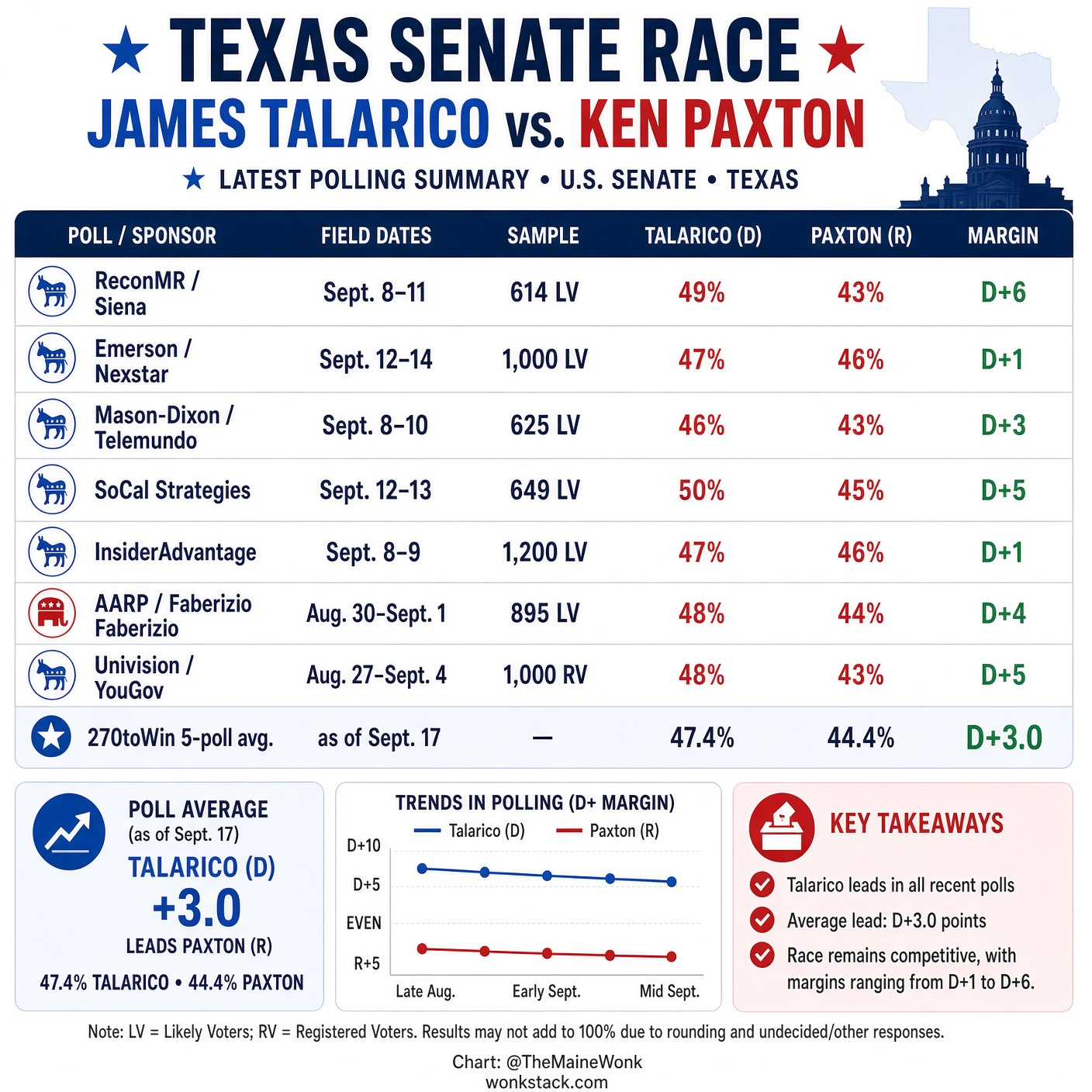
Emerson provides the most recent data this week, shifting from Paxton leading by one point in August to Talarico leading by one after the GOP midterm convention in Dallas. In that survey, Talarico’s favorability is 48–42, while Paxton’s is 40–48.⁹ A candidate trailing in favorability in their own party’s stronghold cannot consider the seat secure.
Cook reclassified the race as a Toss-up in August. As Jessica Taylor noted, this contest would not be competitive if John Cornyn were the nominee.¹⁵ Paxton defeated Cornyn 63.8–36.2 in May, but one-third of Republican primary voters opposed him. ReconMR’s strong independent support for Talarico and the consistent 5–12 percent Republican shift toward Talarico reflect that reluctance more clearly.
Fundraising data demonstrates mounting concern. Talarico raised approximately $72 million compared to Paxton’s $16.8 million through mid-year, and held $21.5 million in cash to Paxton’s $1.8 million.¹⁶ Major Republican PACs began significant spending in September only after polling indicated a competitive race. Large financial investments are made when a race is at risk, not when it is secure.
The path to an upset is clear, and it follows from the shifts above and the thresholds below.
Texas remains structurally Republican. A Talarico victory would not represent a fundamental shift, but rather a targeted campaign against a weakened nominee during a midterm election. Democrats at 90-plus. He is there because the race is about exploiting that opening, not remaking the state.
1. Win independents by 20 to 40. He is there, and ReconMR says the gap is widening.
2. Take Hispanics from 45–55 Trump back to 55–40 Talarico. Every serious survey this month has him at or past that.
3. Win college-educated voters instead of tying them. The crosstabs already show it.
4. Peel enough Cornyn Republicans to cover the rural blowout.
If these five objectives are met, the 2024 electoral map will not secure a win for Paxton. Midterm elections typically disadvantage the president’s party. Trump’s Texas majority rested on economic and border issues, but the same coalition is now fraying. While economic concerns remain, the border message is now tied to an impeached attorney general with a negative favorability rating, while Talarico is focusing on child care and cost-of-living issues.
For three decades, Democrats have anticipated gains in Texas. In most cycles, they selected candidates who were not well-matched against their Republican opponents. This cycle, they have nominated a candidate focused on cost of living, running against the one Republican who could turn a 14-point Trump victory into a competitive race that requires major GOP investment.
The 2024 landslide, the shift among Hispanic voters, and the college-educated vote patterns were all significant. But those trends have now reversed, as the polling above and the board below show. So assuming this seat is secure based solely on Trump’s previous victory is no longer accurate.
Talarico is not relying on a potential coalition shift; the polling above shows it has already occurred. That is why he leads now.
-Maine
🫎🇺🇸🦞
X
Instagram
Facebook
TikTok
BlueSky
Site: wonkstack.com
Notes
1. ReconMR poll of 614 likely voters, Sept. 8–11, 2026, Fort Worth Star-Telegram, Sept. 17, 2026; Emerson College Polling / Nexstar / The Hill, 1,000 likely voters, Sept. 12–14, 2026; Mason-Dixon / Telemundo, Sept. 8–10, 2026; 270toWin Texas Senate average, Sept. 17, 2026.
2. Texas Tribune poll tracker, updated Sept. 17, 2026.
3. Texas Secretary of State, Official Canvass Report, November 5, 2024 General Election; Associated Press / Texas Tribune certified totals.
4. The American Presidency Project, 2020 Texas presidential results.
5. Edison Research / National Election Pool Texas exit poll, November 2024, as reported by the Texas Politics Project and Axios San Antonio.
6. Jim Henson and Joshua Blank, “Trends in Latino attitudes in Texas foreshadowed Trump’s gains in 2024,” Texas Politics Project, January 13, 2025.
7. Pew Research Center, “How voting patterns changed in the 2024 election,” June 26, 2025.
8. Edison Research / National Election Pool Texas exit poll, education breaks (Washington Post Texas exit-poll interactive).
9. Emerson College Polling / Nexstar, Sept. 12–14, 2026; Spencer Kimball comments reported by USA TODAY Network, Sept. 17, 2026.
10. Cook Political Report and TelevisaUnivision poll of 1,000 Texas Hispanic likely voters, OnMessage Inc. and Hart Research, August 26–September 3, 2026.
11. James Henson, quoted in CNN Politics, December 7, 2025.
12. University of Texas / Texas Politics Project statewide poll and crosstabs, August 5–13, 2026.
13. Mason-Dixon Polling & Research / Telemundo, Sept. 8–10, 2026, USA Today and El Paso Times.
14. ReconMR / Siena, Sept. 8–11, 2026, Fort Worth Star-Telegram.
15. Jessica Taylor, Cook Political Report, May 26 and August 20, 2026.
16. Texas Tribune, campaign-finance reporting, July 20, 2026; FEC filings through June 30, 2026.