


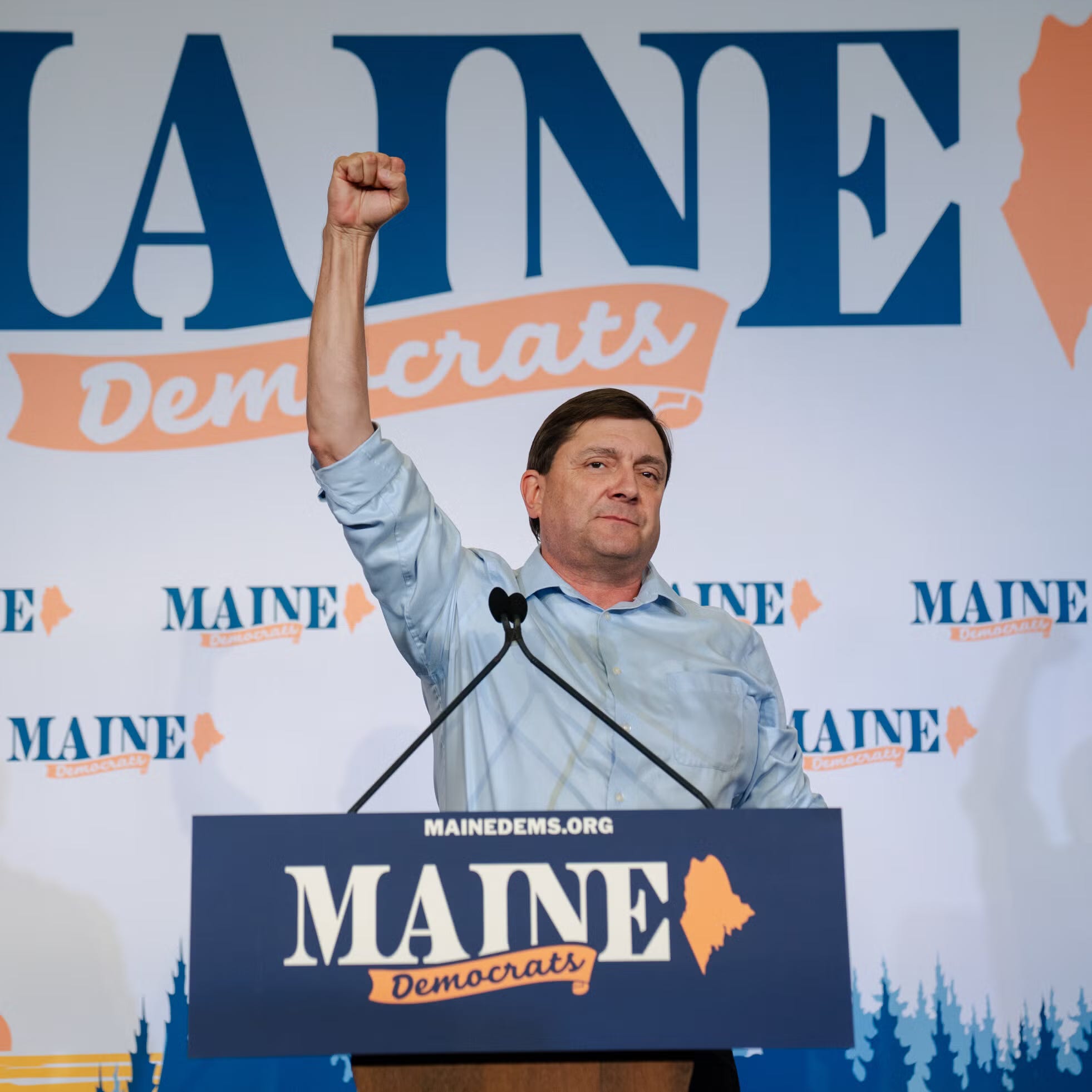
For 30 years, Susan Collins has been the face of Maine’s ticket splitting. She won by 37 in 2014, 23 in 2008, 17 in 2002, and still by 8.6 against Sara Gideon in 2020, even as Joe Biden carried the state by 9. That pattern ends on Election Eve.
Final polls: Jackson’s lead is real, and the gender/independent math has shifted
The last round of high-quality surveys shows a consistent Jackson edge:
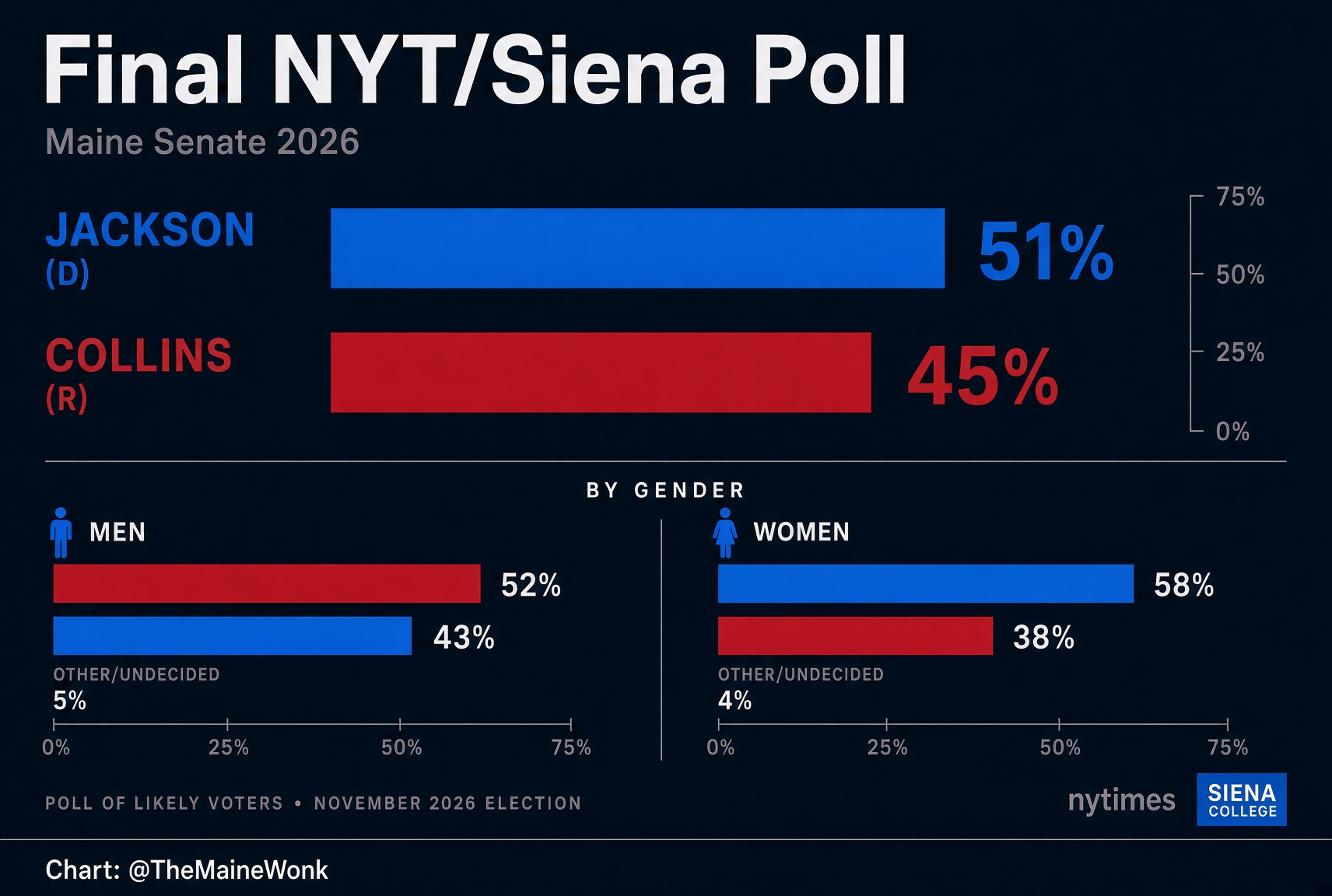
NYT/Portland Press Herald/Siena (Oct 27–Nov 1, 714 LV): Jackson 51, Collins 45 (+6). Margin of error ±4.3. That’s a 9-point swing on from their September poll (Collins 49–46).
UNH Survey Center (Oct 27–31 ~1,650 LV): Jackson 54, Collins 45 (+9).
YouGov (Oct 26-29, 1,503 LV): Jackson 52, Collins 47 (+5).
Data for Progress: Jackson 50, Collins 45 (+5).
CNN/SSRS: Jackson 49, Collins 45 (+4).
Marist: Jackson 49, Collins 47 (+2).
Aggregators have Jackson at roughly +3 to +5.6, and the prediction markets are in the mid-70s for Jackson.
The independents/unenrolled (roughly one third of the electorate) have moved. In the final NYT/Siena poll, Jackson leads the unenrolled 52-41. That’s a clear swing from September, when they were level at 47 among the independents. Marist’s late October likely voter sample also had Jackson ahead of independents (50-41). Those voters will decide the Maine Senate race.
The gender gap has narrowed among men. In the final NYT/Siena poll:
Women: Jackson 58, Collins 38
Men: Collins 52, Jackson 43
In the September survey, Collins led men 54–38. Jackson cut that gap by five points as he increased his lead among women. Collins still takes men, but the margin is not quite as wide as it was in 2020 (she won men 55–36 then). Women remain the larger share of the electorate.
Other consistent themes across the final surveys: Jackson is very strong with under-45 voters and the college-educated; Trump’s Maine approval is in the low to mid 30s in most polls; a large proportion of Jackson voters and independents describe their vote as a message against Trump.
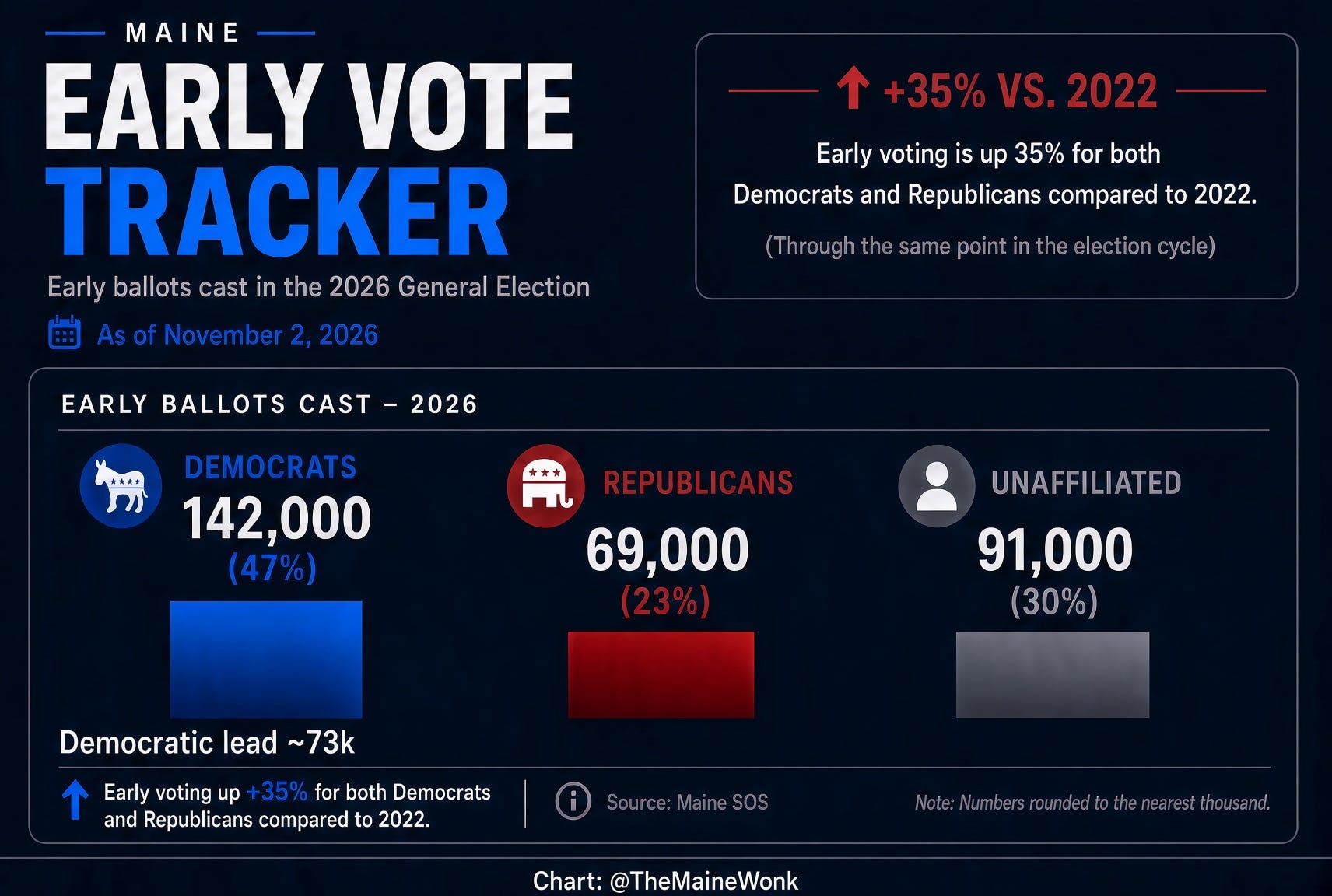
Early vote: Today’s SOS update shows a ~73k Democratic lead
As of approximately 3 p.m. on Monday, November 2nd the Maine Secretary of State reported 302,353 absentee and early in person ballots returned and accepted (out of 324,443 issued).
Party registration of those ballots (from the detailed SOS file):
Democrats: 142,100 (47.0%)
Republicans: 68,900 (22.8%)
Unenrolled/Independent: 91,300 (30.1%)
That’s a raw Democratic lead of 73,200 ballots.
This is bigger than the ~56k Democratic early lead they had heading into Election Day in 2022. Democratic early volume is up by around 41% from the last midterm at the same point and is close to 2024 presidential early volume in a midterm. Early voting overall remains well ahead of 2022.
Approx. 31% of all registered voters in Maine have already voted. At a realistic ~61% turnout at the midterms, that would mean just over half the expected electorate has already cast their vote. A large portion of the outcome is already in hand, and the unenrolled are the big swing group by a long way. They account for nearly a third of the early votes and will decide how much of the early Democratic lead is ultimately maintained.
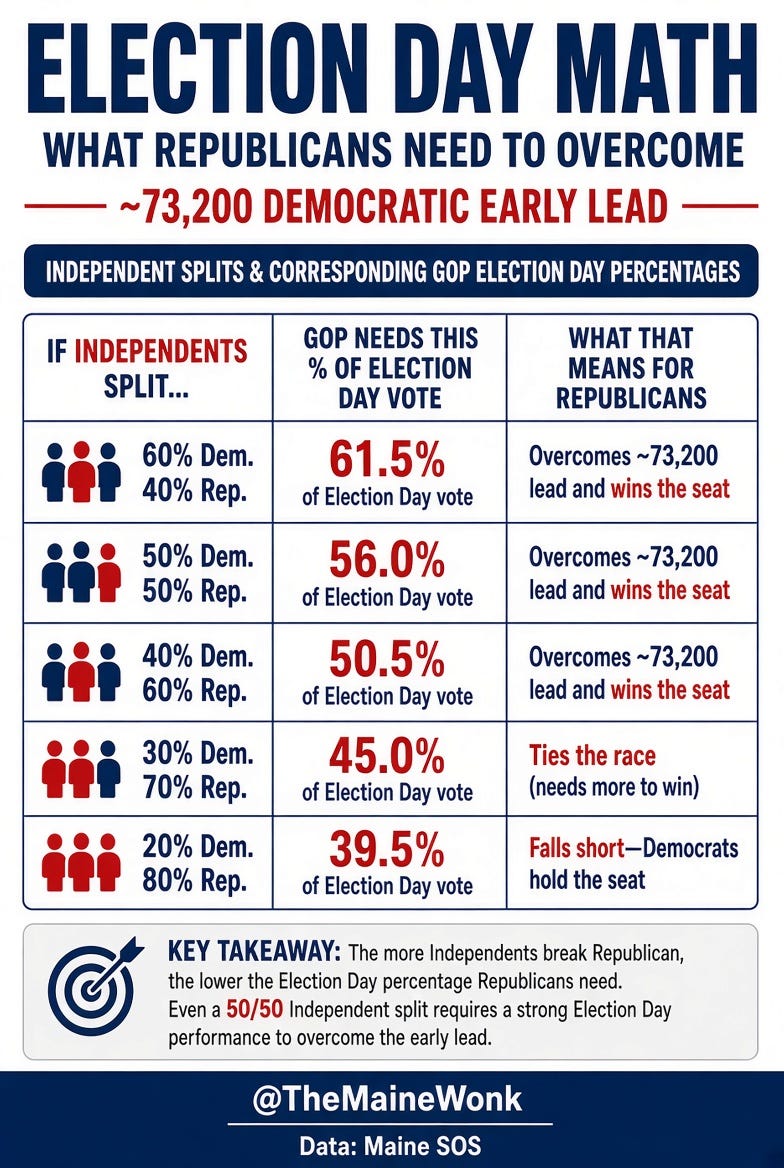
Election Day scenarios: What Republicans need to overcome the early lead
Party registration is not a vote. Early ballots are overwhelmingly Democratic, and Election Day has traditionally been more Republican. Collins has a well-documented history of ticket splitting. That said, a ~73k early gap is a big gap by Maine midterm standards.
Assuming ~61% total turnout, the GOP needs roughly 57-62% on Election Day, depending on how the independents break, to wipe out the early Democratic lead. Even in a strong GOP independent scenario (60-40), they could still win if Democrats get low to mid 40s on Election Day. Historically, Election Day is red, and Collins tends to outperform with the ticket splitters, but that’s a massive climb by Maine midterm standards.
Approximate GOP Election Day margins required under various independent splits (illustrative, based on the current early composition and typical midterm turnout):
Independents break 51/49 Dem: Republicans need a solid double-digit Election Day margin.
Independents break 51/49 GOP: Republicans need a high single- to low double-digit Election Day margin.
Independents break 55/45 Dem: Republicans need a larger double-digit Election Day margin.
Independents break 55/45 GOP: Republicans need a modest double-digit Election Day margin.
Independents break 60/40 Dem: Republicans need a very large Election Day margin.
Independents break 60/40 GOP: Republicans need a margin in the mid-teens on Election Day.
Independents break 70/30 Dem: Republicans need an extreme Election Day blowout to have any chance.
Independents break 70/30 GOP: Republicans can still win with a solid, if more achievable, Election Day performance.
Polling has consistently shown Jackson ahead of the field among independents by the high single digits to low double digits. If that continues on Election Day, the early lead will be very hard to overcome.
Bottom line
Troy Jackson is now in the best possible position that any Democrat has ever been in to unseat Susan Collins. No Democrat who has ever challenged Susan Collins has come into the election with this package: consistent final poll leads of 4–9 points, strength with women and independents, a much reduced (though still there) male gap, a larger raw early vote advantage than in 2022 (~73k ballots) and a very toxic presidential approval environment. The last time Maine elected a Democrat to the U.S. Senate was George Mitchell’s 1988 landslide. 38 years on, the fundamentals, the final polls, and the early vote favor Jackson.
Tomorrow isn’t a lock. Ranked-choice voting, the residual mail, and Election Day turnout composition still count. The data just doesn’t support the ‘old way always finds a way’ narrative.
- Maine
🫎🇺🇸🦞
X
Instagram
Facebook
TikTok
BlueSky
wonkstack.com